
Shuku and Niku
Mahin Banu’s Baby. Written in four vignettes, No. 4.

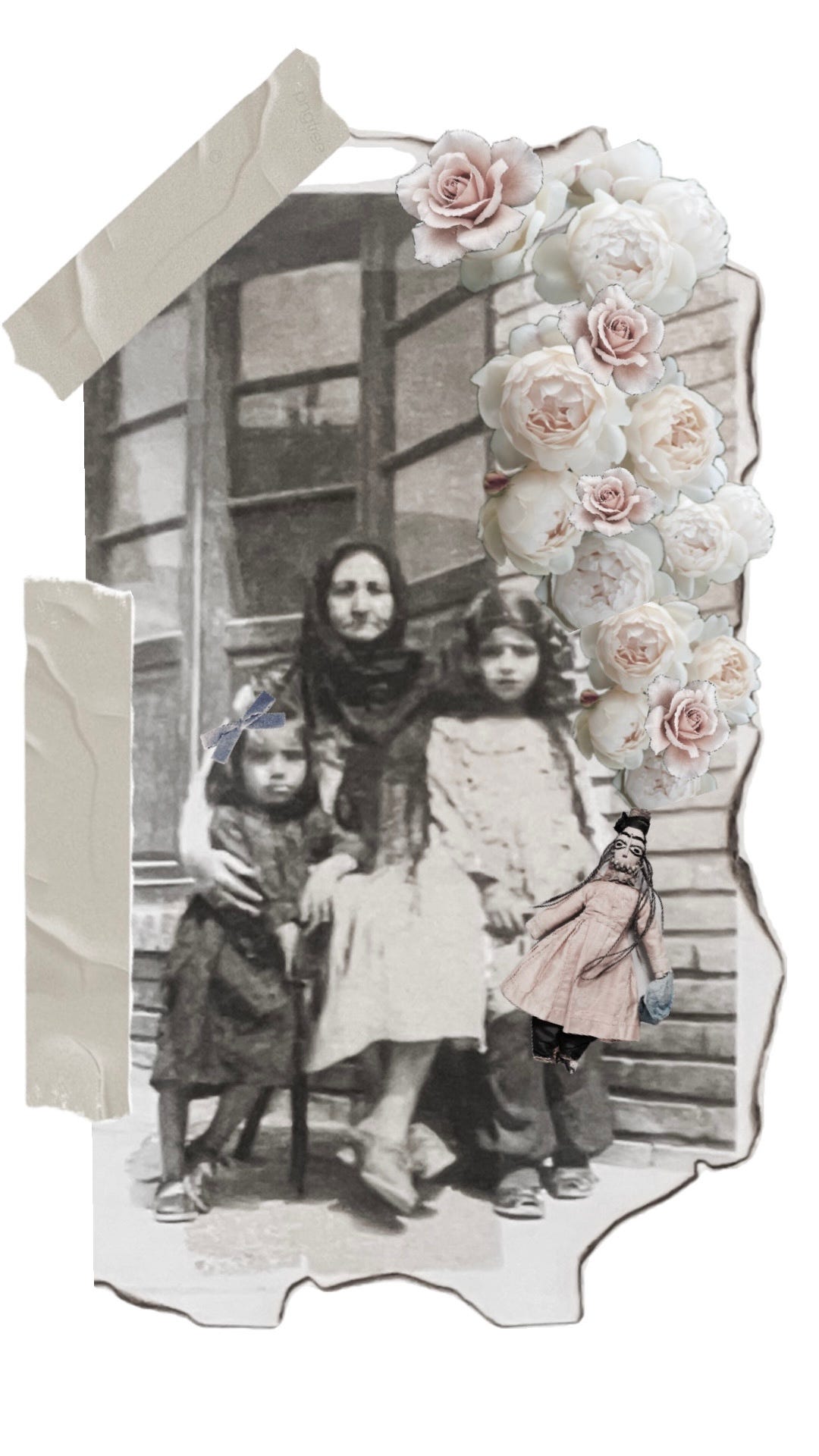
Shuku propped the bisque-faced doll up on her lap. It was an ugly doll. Nothing like her delicate, golden-haired bébé. Flat, black eyes covered half its vacant face. Its painted eyebrows stretched from one temple to another, like the shadow of a bird in flight. Its body possessed none of the lean, chic curves that her Aunt Heshmat’s figure suggested from underneath her spring dresses. No, the body made no sense at all. An apple, sprung inexplicably from the earth; a potato that dressed itself up in lace one morning and decided to become a doll instead.
“When your sister comes home, make sure to kiss her and give her the gift you bought her,” Khanum Bozorg told her granddaughter.
But Shuku hadn’t bought her sister the doll. Her Aunt Mehri and Aunt Heshmat had handed it over to her when they came home from the bazaar earlier that day.
“Here, give this to your sister when she arrives,” they’d said.
They were always telling Shuku about her sister, but she had never actually seen her in person. She saw her two baby brothers every day and was not impressed. Then again, the brothers were not her mother’s children. The nuns from the American hospital had taken her away on a stretcher one day, pale as a winter moon. Afterwards, Shuku had sneaked into her room and seen her bed that looked as if someone had been eating pomegranates in it. And that was the last she ever saw of her.
Aunt Mehri had moved in shortly after that. Aunt Mehri was her mother’s sister, and was nowhere near as beautiful as Mahin Banu. Her two brothers both resembled her. Her sister though, her real sister, would probably look just like Mahin, would look just like Shuku herself. She would not be Aunt Mehri’s. Her real sister would be all hers.
Every night before bed, Shuku asked her Aunt Heshmat about her sister who lived on the south side of the city. “Tell me about my sister,” she’d beg. And her aunt would. Shuku was convinced she could remember her. She had played the stories over in her head so many times, there was no doubt she remembered. They looked alike, that much she had established. Same bunched curls hanging down their small backs like grapes; same pink lips, like they had just devoured an entire bouquet of strawberries.
Shuku turned the doll upside down and inspected where the feet should be. But there were none. Just two stumps protruding out of the potato body.
“Don’t ruin the doll,” said Khanum Bozorg. “Hold it like this.” She turned it upright. “There; they should be here any minute now.”
Shuku crossed her ankles and waited. At last, came the familiar afternoon sounds of creaking doors, rushed pitter-patter, hushed chitter-chatter and the shuffling of her father’s tweeds. Shuku heard her father and her Aunt Mehri conversing through smiles. She couldn’t hear her sister, but could feel her in the front corridor with them.
“Shuku-Jun, look who’s here. Come meet your sister,” said her father, walking into the salon. “Oh! And look at what she’s brought for you!”
Shuku looked at the little girl holding the box of sweets in front of her. Surely, this was not her sister. Shuku’s hair was long and curly and the color of sand. Every morning, her Aunt Heshmat brushed through her hair, pinning the sides back with two turquoise-encrusted combs. Her shalvars were blue like the peacocks that had once belonged to her mother, her dresses were lacy and white.
But this girl, this girl had straight hair the color of mud. Even the dress and stockings covering her skinny deer legs were mud. Like the doll, her eyes took up half her face.
Niku offered her sister the box of baqlava. Two pieces were missing. Traces of phyllo dough and pistachio crumbs stuck on Niku’s face confirmed who the culprit was.
Shuku snatched the box out of her sister’s hands.
“Now, give Niku the gift you got her,” said Khanum Bozorg.
But in a moment of passion, Shuku refused.
“No!” she yelped, darting past her grandmother’s clutches and off into the garden.
“Shuku!” scolded Khanum Bozorg, but the child was gone and her old legs were too tired to go running after anybody. “Don’t worry, Niku-Jun. I’ll find you a toy to play with.”
Niku looked up at her grandmother with blank deer eyes that matched her deer legs.
Khanum Bozorg turned to her son. “Does the child not speak?”
“She says ‘yes’ and ‘no,’” whispered Asqar Aqa. He smiled uncomfortably at Niku.
Khanum Bozorg took Niku’s hand and led her to the korsi, where she was knitting a hat for Shuku. “Sit here, Niku-Jun.”
Niku obeyed her new grandmother.
“Let’s see…what do I have for you here? Oh, look here is a nice piece of yarn. Now, can you tell me what color it is?”
The child said nothing.
“It’s green!” cried Khanum Bozorg with lone enthusiasm. She handed Niku her new toy.
“Are you hungry?”
Niku nodded.
“All right then, look what I have for you.” She scooted the silver tray resting next to the window over to her swollen legs, ripped up several pieces of poppy seed bread and dipped one into a bowl of yogurt. “Here, the biggest piece for you. Open your mouth.”
Niku stretched her mouth as wide as it went and looked to the side, her eyes bulging out of her head.
“That’s my girl,” said Khanum Bozorg, pinching the child’s cheek.
Niku chewed and smiled proudly, both cheeks stuffed with bread. Through the window, she noticed Shuku prancing around the pool like a mischievous gazelle. She was swinging her new doll carelessly by the arms, when she suddenly caught sight of her grandmother and little sister sitting by the korsi in the salon.
There they were, in the midst of their glorious feast. Shuku stopped, the doll still dangling at her side. Her eyes met Niku’s in one wounded hummingbird of a moment, and off she dashed again.12
written by Alaleh Mohajerani
an earlier version of this text was first published by Cardiff University in 2008, and later featured in an anthology published by Cinnamon Press, entitled Black Waves in Cardiff Bay, also in 2008
Deer eyes and deer legs 🥹This one made me cry.